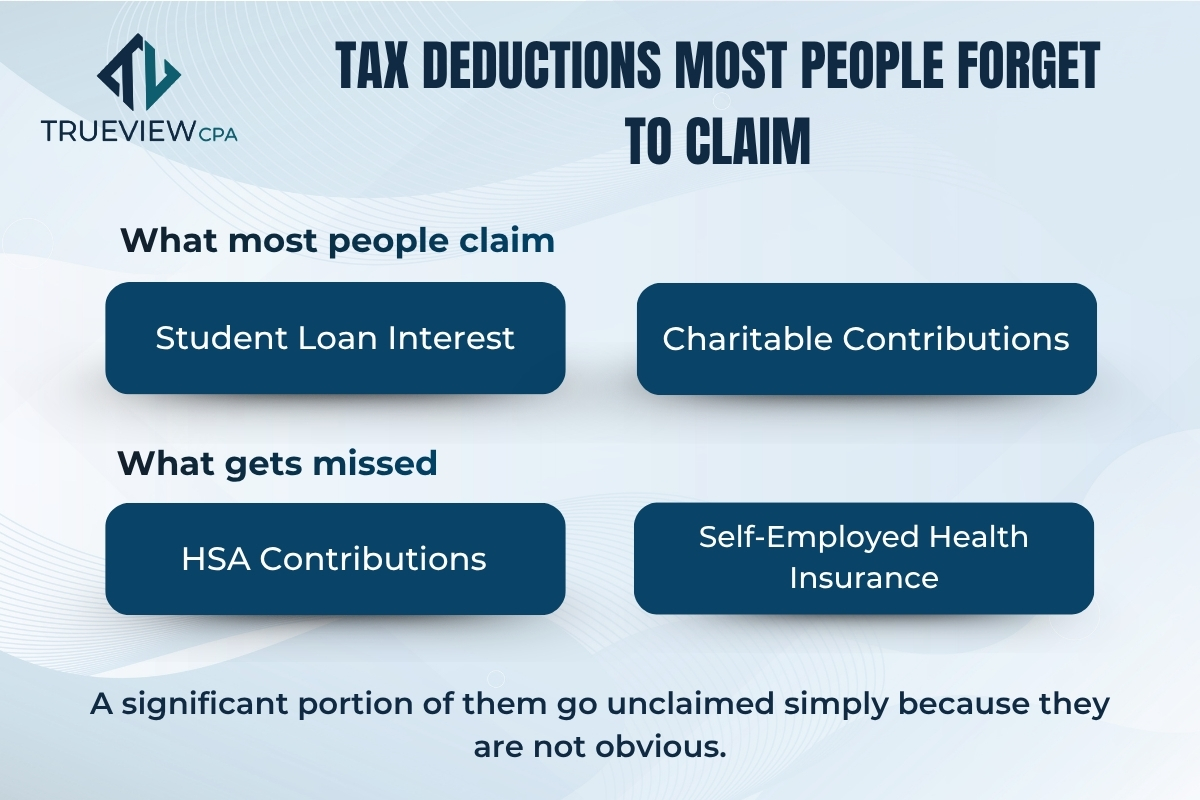
Every year, people across the country overpay their taxes not because they did anything wrong, but because they did not know what they were allowed to deduct. The US tax code gives individual filers a surprising number of legitimate ways to reduce taxable income, and a significant portion of them go unclaimed simply because they are not obvious.
If you are preparing your 1040 tax return for 2025, here are the deductions and credits most commonly missed, and how to make sure you are not leaving money behind.
Most people know they can deduct up to $2,500 in student loan interest they paid during the year. What fewer people know is that you can claim this deduction even if someone else, such as a parent, made the payments on your behalf, as long as you are legally obligated on the loan and cannot be claimed as a dependent.
This deduction is above the line, which means you do not need to itemize to take it. It reduces your adjusted gross income directly, which can also affect your eligibility for other credits and deductions.
If you are self-employed and pay for your own health insurance, those premiums are fully deductible as an above-the-line deduction on your 1040 tax filing. This includes coverage for yourself, your spouse, and your dependents.
This deduction does not require Schedule A and is not subject to the 7.5% AGI floor that applies to medical expense deductions for regular employees. It is one of the more valuable deductions available to freelancers and business owners, and it regularly gets missed by people doing their own personal tax preparation for the first time after leaving traditional employment.
If you are self-employed and use a portion of your home exclusively and regularly for business, you can deduct either a simplified flat rate of $5 per square foot up to 300 square feet, or a percentage of your actual home expenses based on the proportion of your home used for business.
The key word is exclusively. A room where you sometimes work and sometimes watch television does not qualify. But a dedicated home office or a portion of a room used solely for business does. This deduction is available on Schedule C and applies to renters as well as homeowners.
If you contributed to a traditional IRA during 2025, those contributions may be deductible depending on your income and whether you or your spouse has a retirement plan at work. For 2025, the contribution limit is $7,000, or $8,000 if you are 50 or older.
Even if you cannot deduct the full contribution due to income limits, a non-deductible contribution to a traditional IRA still builds tax-deferred growth. And if you are not covered by a workplace retirement plan, the full contribution is generally deductible regardless of income.
Contributions to a Health Savings Account are deductible even if you do not itemize. For 2025, the limits are $4,300 for self-only coverage and $8,550 for family coverage. If you are 55 or older, you can contribute an additional $1,000 as a catch-up amount.
HSA contributions made directly, meaning not through payroll deduction, are deductible on your 1040 return and reduce your adjusted gross income dollar for dollar. This is one of the only triple-tax-advantaged accounts in the entire tax code, and it is frequently underused.
Teachers, instructors, counselors, principals, and aides who work in a school and spend their own money on classroom supplies can deduct up to $300 in out-of-pocket expenses without itemizing. If both spouses are eligible educators filing jointly, the combined deduction can reach $600.
It is a relatively small deduction, but it is above the line, takes less than a minute to apply, and is missed constantly by educators doing their own 1040 tax preparation.
Starting in 2026 for the tax year 2025 return, non-itemizers can deduct cash donations to qualifying charitable organizations up to $1,000 for single filers and $2,000 for married couples filing jointly. This is a new provision introduced by the One Big Beautiful Bill Act and a change from recent prior years when the above-the-line charitable deduction was not available.
If you donated to charity in 2025 and are taking the standard deduction, this deduction is now available to you on your individual tax return. Keep your donation receipts.
If your employer continued paying your full salary while you served on jury duty and required you to turn over your jury duty pay in return, you can deduct the amount you handed over. This is an above-the-line deduction and one that almost no one knows exists.
The deduction for state and local taxes, including income taxes or sales taxes plus property taxes, is capped at $10,000 for most filers ($5,000 for married filing separately). For 2025, under the One Big Beautiful Bill Act, this cap is temporarily increased. The exact amount depends on your income level, so it is worth confirming what applies to your specific situation.
If you itemize, make sure you are capturing the full allowable amount. People who live in high-tax states and own property often leave part of this deduction on the table by miscalculating their eligible state and local tax payments.
The deductions above are all legitimate, all available to individual filers on a standard 1040 tax return, and all regularly missed in individual income tax filing done without professional guidance. None of them require unusual circumstances. They just require knowing they exist and applying them correctly.
At TrueView CPA, 1040 tax preparation services are built around making sure your return captures everything you are entitled to, not just the obvious items. If you want to know whether you are missing deductions in your current situation, we are happy to take a look.
Want to make sure you’re not missing valuable tax deductions? Schedule a call with our experts to review your tax situation and maximize your savings.
.svg)
.png)
