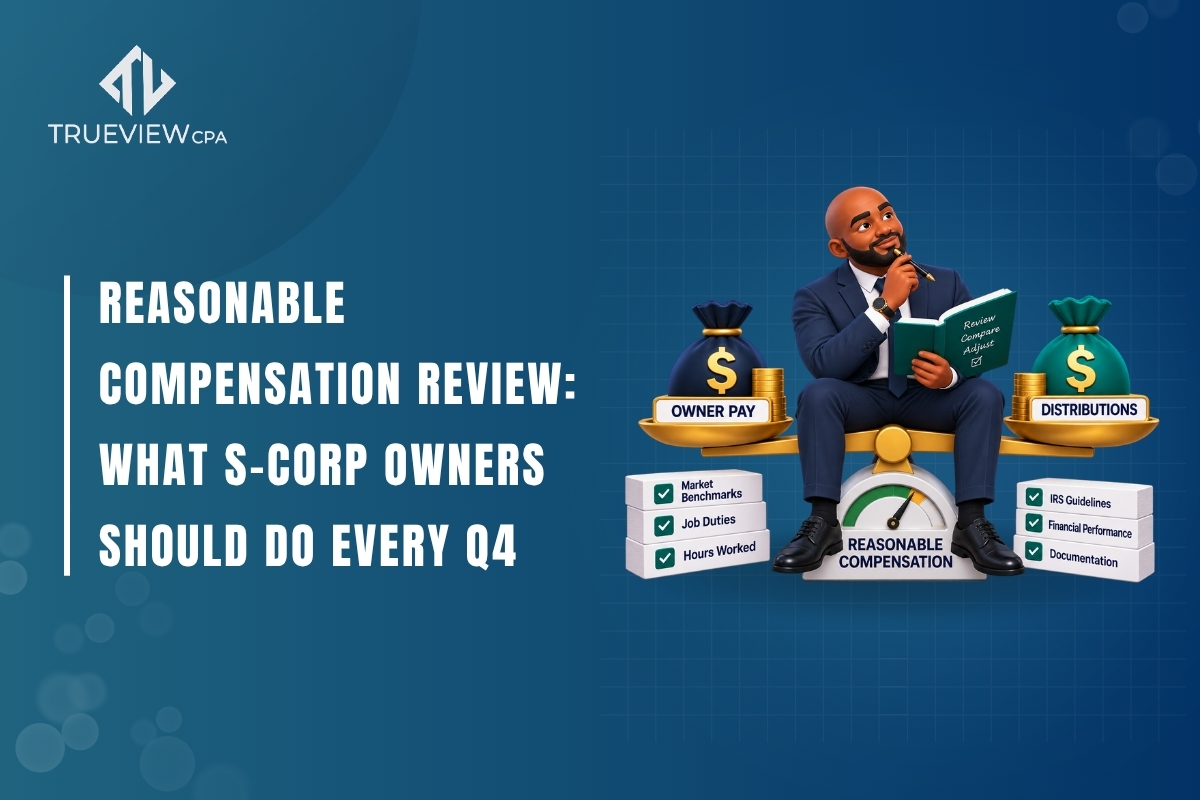
Most S-corp owners set their salary once, at formation or whenever they first heard the requirement existed, and then let it roll forward year after year without revisiting it. That approach works until the business grows, the owner's role changes, profitability jumps, and the IRS notices that the salary has not moved while distributions have climbed steadily. At that point, the conversation shifts from a planning question to a damage control one.
The Q4 reasonable compensation review is not a compliance formality. It is the annual decision that determines how much of the corporation's income is exposed to payroll taxes, how much qualifies for the QBI deduction, and whether the salary on the return will survive IRS scrutiny if the corporation is ever examined. Getting it right before December 31 costs far less than explaining it after a notice arrives.
The salary paid to an S-corp owner-employee must be reasonable for the services they performed during the year. The IRS evaluates reasonableness based on facts and circumstances as of the tax year, not as of when the business was formed. That means the right salary for this year depends on what happened this year, such as how the business performed, what the owner actually did, and what the market would pay for that role and that revenue level in 2026.
Q4 is the right time to review because it is the last opportunity to make adjustments before the year closes. If the business had a significantly better year than projected, the salary may need to be adjusted upward before December 31 to reflect the increased revenue and the owner's continued contribution to generating it. If the owner's role changed during the year, the salary needs to reflect that change. A December payroll bonus is one of the most common and effective tools for bringing year-end compensation into alignment with what the IRS would expect without overcorrecting throughout the year.
Tip: Courts have looked unfavorably at S-corps that pay minimal salary throughout the year and then make no adjustment when profitability turns out to be higher than expected. A year-end bonus before December 31 that brings total compensation to a defensible market rate is a legitimate and well-accepted practice. A salary that stays flat while distributions grow is a pattern the IRS recognizes and pursues.
Before any salary decision can be made, the owner needs a clear picture of where the year landed. That means reviewing the profit and loss statement through the most recent month, estimating Q4 income based on current trends, and projecting the year-end ordinary income figure that will appear on the Form 1120-S.
That projected income figure is the starting point for two separate calculations. The first is the payroll tax cost of the current salary on an annualized basis. The second is the income that will flow through to each shareholder on their K-1 as a distribution, which is the amount that avoids payroll taxes but is subject to income tax. The gap between total corporate income and the owner's salary is the distribution amount, and the tax efficiency of the entire S-corp structure depends on that gap being large enough to produce meaningful savings while the salary is large enough to survive scrutiny.
Tip: If the corporation's Q4 income is tracking significantly above the first three quarters, resist the instinct to simply keep the salary unchanged and take the difference as distributions. Run the numbers on what a year-end salary adjustment would cost versus what an IRS reclassification of those distributions would cost if the salary is later found to be unreasonable. In most cases, the voluntary adjustment is significantly less expensive.
Reasonable compensation is the amount a comparable business would pay an unrelated employee to perform the same services in the same geographic area. The IRS does not accept a percentage of profit, a rule of thumb, or a number chosen because it feels appropriate. It wants evidence that the salary reflects what the market would actually pay, and the only way to produce that evidence is to look at what the market actually pays.
The sources that carry the most weight in IRS examinations and Tax Court cases include:
The market data review does not need to be exhaustive. It needs to be documented. A one-page memo that identifies the role, lists the sources consulted, summarizes the salary range those sources support, and states the compensation decision for the year is what the IRS expects to find on examination. The absence of that memo is what turns a routine audit into an expensive one.
Tip: The 2026 Social Security wage base is $184,500. For S-corp owners whose salary approaches or exceeds that level, the Social Security component of payroll taxes phases out above that threshold, and only the 2.9 percent Medicare rate applies to wages above it. That affects the marginal cost of additional salary above the wage base and should be factored into the year-end compensation decision.
The One Big Beautiful Bill Act made the Section 199A qualified business income deduction permanent for 2026 and beyond. That changes the salary optimization calculation in a way that every S-corp owner needs to understand before setting year-end compensation.
The W-2 salary paid to the owner-employee is not qualified business income. Only the distribution portion flowing through the K-1 qualifies. Every dollar the owner takes as salary rather than distribution reduces the QBI deduction by 20 cents on the dollar. For an owner in a 22 percent bracket with $100,000 in distributions, the QBI deduction saves approximately $4,400 in income tax. Shifting $20,000 from salary to distributions at the margin costs $3,060 in payroll taxes but saves $880 in income tax through the expanded QBI deduction: a net payroll tax cost of $2,180 on the shift.
That math changes above the phase-out thresholds, which is approximately $191,950 for single filers and $383,900 for joint filers in 2026, where the QBI deduction begins to phase out and may be eliminated entirely for owners of specified service trades or businesses. For those owners, the salary decision is less about the QBI tradeoff and more about identifying the defensible minimum salary supported by market data.
Tip: For S-corp owners who are near but not above the QBI phase-out threshold, the salary decision affects whether they remain below that threshold. A higher salary reduces QBI income, which reduces the risk of phasing out. A lower salary increases distributions, which may push modified adjusted gross income closer to or above the threshold. Model the full picture before deciding on year-end compensation.
The salary decision needs to be documented before the final payroll of the year is run. A contemporaneous written record showing that the compensation was reviewed, that market data was consulted, and that the final figure was set based on that analysis is what separates a defensible return from one that relies on the IRS never asking.
The documentation does not need to be lengthy or formally prepared. It needs to exist, be dated, and reflect the actual analysis that was performed. At minimum it should include:
Keep that documentation with the corporate records alongside the payroll records for the year. The IRS asks for prior years' records during examinations and can request documentation going back three years or more. A file that contains an annual compensation memo going back multiple years demonstrates a consistent, deliberate process that is significantly harder to challenge than a salary with no paper trail.
Tip: If the corporation issued a year-end bonus to bring total compensation to the defensible range, document the bonus decision separately from the regular salary determination. The bonus should be recorded in the board minutes or a written resolution, supported by the same market data analysis, and processed through payroll before December 31. A bonus paid in January for the prior year is income in January, not in December.
Everything above is preparation. The decision that actually matters is the one the corporation acts on before the final payroll of the year is processed. If the salary needs to be adjusted, the adjustment must appear on a W-2 for the current tax year. Payroll processed after December 31 is income in the following year regardless of what year it was intended to cover.
For corporations running biweekly or semi-monthly payroll, confirm whether there is a final pay date remaining in December before the year closes. For corporations running monthly payroll, the December payroll is the last opportunity. A year-end adjustment that misses the final payroll date has to wait until the following year, which means the current year return goes out with a compensation figure that may not reflect the final determination.
Tip: Confirm the corporation's final payroll date for 2026 before November ends. For many payroll systems, the processing cut-off for a December 31 pay date falls in mid-December. Missing that cut-off is a common and entirely preventable source of year-end compensation errors.
The annual Q4 reasonable compensation review protects three things simultaneously. It protects the current year Form 1120-S from the most commonly audited issue on S-corp returns. It protects each shareholder's personal return from the downstream effects of a corporate-level reclassification. And it creates a documented record that demonstrates to the IRS, if it ever asks, that the salary was set deliberately and reviewed consistently rather than minimized to reduce payroll taxes.
At TrueView CPA, reasonable compensation analysis is part of every S-corp tax preparation engagement we handle. If you want to review your current salary determination before the year closes, or need S-corp tax consulting services that include building and documenting the compensation strategy correctly, we are ready to start with a conversation.
Need help reviewing your S-Corp compensation? Schedule a call with our tax experts today.
.svg)
.png)
