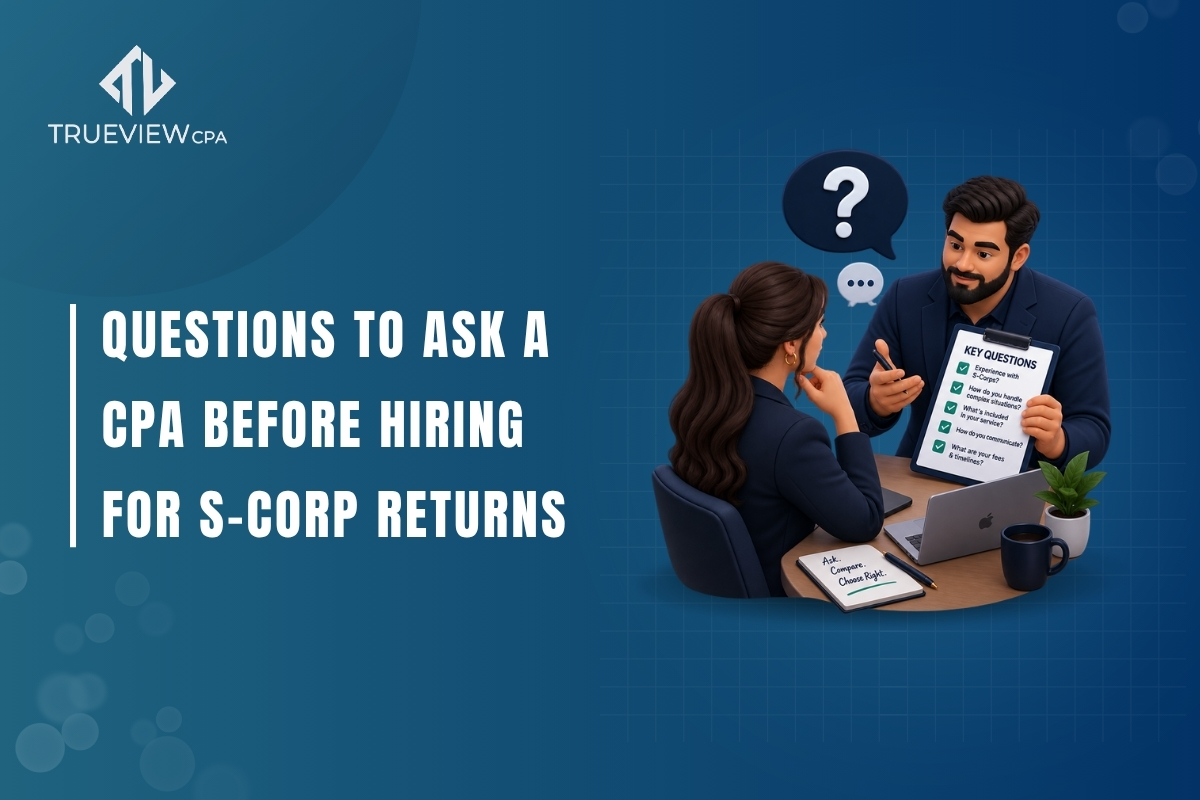
Hiring a CPA to prepare your Form 1120-S is not the same as hiring a CPA to prepare a personal return. The technical knowledge required to handle an S-corp return correctly, such as setting and documenting reasonable compensation, maintaining the accumulated adjustments account, tracking shareholder basis on Form 7203, reconciling Schedule K totals to every K-1 issued, is not part of general tax practice. Most CPAs can file your taxes. Fewer can prepare an S-corp return the way it needs to be prepared.
The questions below are the ones worth asking before you hand over your documents. The answers will tell you quickly whether you are talking to someone who treats the 1120-S as a specialty or as a checkbox.
Volume alone does not define expertise, but it is a reasonable starting point for the conversation. A CPA who prepares a handful of Form 1120-S returns each year alongside hundreds of individual returns approaches the return very differently from one whose practice is built around S-corp tax preparation. Ask the question directly, and follow up by asking what percentage of their practice involves business entities versus individual returns. The answer tells you where your return sits in their priority and their experience.
A CPA who specializes in S-corp returns should be able to speak fluently and without prompting about reasonable compensation documentation, accumulated adjustments account maintenance, and Form 7203 shareholder basis tracking. If those topics require explanation on their end, that tells you something.
Tip: Ask specifically whether they handle the payroll setup and quarterly filings alongside the annual Form 1120-S, or only the year-end return. A CPA who is involved in both has a more complete picture of the corporation's compliance and is better positioned to catch issues before they become problems on the annual return.
This is the question that most clearly separates a CPA who understands S-corp compliance from one who is guessing. According to the IRS, unreasonable or absent officer compensation is the most consistently audited issue on Form 1120-S returns. The salary paid to an owner-employee must reflect the fair market value of the services they perform, and that determination must be documented with market data.
The right answer is that reasonable compensation is analyzed using Bureau of Labor Statistics occupational wage data, industry-specific salary surveys, and a written memo documenting the shareholder's role, hours, and qualifications. The wrong answer is a percentage of profit, a rule of thumb, or a number chosen for convenience. The IRS does not have a 60/40 rule or any safe harbor ratio. It compares the salary to what the market would actually pay for the role, and it wins these cases when the documentation is not there.
Tip: Ask whether the compensation analysis is prepared in writing and kept on file. A verbal determination that nobody wrote down is not a defense if the IRS questions the salary. Watson v. Commissioner and Radtke v. United States are both cases the IRS won because the salary was set without reference to market data. The written documentation is what separates a defensible return from one that is exposed.
The accumulated adjustments account is the pool of previously taxed earnings that can be distributed to shareholders tax-free. It is tracked on Schedule M-2 of the Form 1120-S, and the opening balance each year must match the closing balance from the prior year return exactly. A CPA who does not know what the AAA is, or who cannot explain how it increases and decreases, is not the right fit for an S-corp return.
The right answer is that the M-2 is prepared from the prior year closing balance, updated for the current year's income, losses, nondeductible expenses, and distributions, and reconciled before the return is filed. A distribution that exceeds the AAA is not tax-free; it is a return of capital up to the shareholder's stock basis and then capital gain, and the shareholder's personal return needs to reflect that correctly.
Tip: If your S-corp has been filing for several years and nobody has ever discussed the AAA with you, ask to see the Schedule M-2 on your most recent return and confirm the opening balance matches the prior year's closing balance. A discrepancy between those two numbers indicates an error in a prior year that is compounding forward.
A shareholder's ability to deduct losses from the S-corp on their personal return is limited by their tax basis in the corporation. Beginning with the 2021 tax year, the IRS requires shareholders to complete Form 7203 to track stock and debt basis whenever they claim a loss, receive a distribution, dispose of stock, or receive a loan repayment. A CPA who cannot describe how they track shareholder basis annually is likely not doing it.
The right answer is that basis is tracked from year to year using the K-1 figures and updated for contributions, distributions, and any shareholder loans. The opening balance on the current year's Form 7203 should match the closing balance from the prior year. Losses that exceed basis are suspended and carry forward (they do not disappear) and distributions that exceed basis produce capital gain, not tax-free income.
Tip: If you have received losses on a K-1 that you were not able to fully deduct on your personal return, ask whether those suspended losses are being tracked. A loss that is suspended in one year becomes deductible in a future year when basis is restored, but only if someone is keeping track of it. Suspended losses that are not tracked are effectively lost.
The Form 1120-S and each shareholder's personal return are not independent documents. The K-1 that flows from the corporate return feeds directly into each shareholder's Form 1040, and the decisions made at the entity level, such as how income is classified, how compensation is structured, how distributions are characterized, affect each shareholder's income tax, estimated payment obligations, and deduction picture for the entire year.
A CPA who prepares the 1120-S without involvement in the shareholders' personal returns is working with incomplete information in both directions. They do not know how the income allocation will affect each shareholder's personal tax picture, and the shareholder's personal preparer typically does not have enough context about the corporate return to catch errors in the K-1 before accepting it.
Tip: If different CPAs handle the corporate return and the personal returns for the same shareholders, ask specifically how they communicate. An active coordination between preparers is what prevents a K-1 error from going undetected until someone receives an IRS notice. The absence of that coordination is one of the most common sources of errors that persist across multiple years.
Most CPAs who prepare S-corp returns for general clients do not check whether the election is still valid every year. A CPA who specializes in S-corp work does. The S-corp election terminates automatically when the corporation exceeds 100 shareholders, admits an ineligible shareholder such as a non-resident alien or a disqualified trust, creates a second class of stock through preferential distribution arrangements, or accumulates too much passive income for three consecutive years while carrying prior C corporation earnings and profits.
A corporation operating under a terminated election is filing the wrong return, and the IRS may not catch it immediately. The correction process is expensive, involves potential back taxes and amended returns, and requires IRS consent to re-elect S-corp status within five years of termination.
Tip: Ask whether the CPA reviews the S-corp eligibility requirements as part of the annual preparation process. The answer should be yes without hesitation. If any ownership changes occurred during the year, if any trusts or estates entered the shareholder group, or if the corporation carried accumulated C corporation earnings and profits with significant passive income, those all need to be reviewed before the return is filed.
S-corp tax return preparation is more involved than most clients expect, and pricing varies significantly depending on the number of shareholders, the complexity of the return, whether payroll compliance is included, whether state filings are required, and whether the reasonable compensation determination requires fresh analysis. A CPA who quotes a flat fee without asking about any of those factors is either underscoping the work or standardizing at a level that will not serve a complex corporation well.
Ask specifically what is included in the quoted fee. Does it cover K-1 preparation for all shareholders? Shareholder basis tracking? Coordination with personal returns? The reasonable compensation analysis? State filings? Mid-year ownership changes? The engagement letter should be specific, and the fee should reflect the actual scope of the work rather than a number that seemed reasonable before anyone understood the situation.
Tip: The fee paid to a CPA for S-corp tax preparation services is a deductible business expense for the corporation. The penalties, back taxes, professional fees to respond to an audit, and cost of filing amended returns when errors are found are not. A higher fee for thorough preparation is almost always less expensive than the downstream cost of inadequate preparation.
A CPA who can answer these questions confidently and specifically is a CPA who actually does this work the way it needs to be done. Most shareholders have never asked these questions because nobody has told them they should. Asking them once, before the engagement starts, tells you more about the quality of the return you are going to receive than any amount of research afterward.
At TrueView CPA, S-corp tax return preparation and S-corporation tax filing services for business owners across Dallas and Texas are built around being able to answer every one of these questions with specifics, not generalities. If you are evaluating CPAs for your 1120-S this year, we are happy to start with exactly this conversation.
Looking for the right CPA for your S-Corp return? Schedule a call with our tax experts today.
.svg)
.png)
