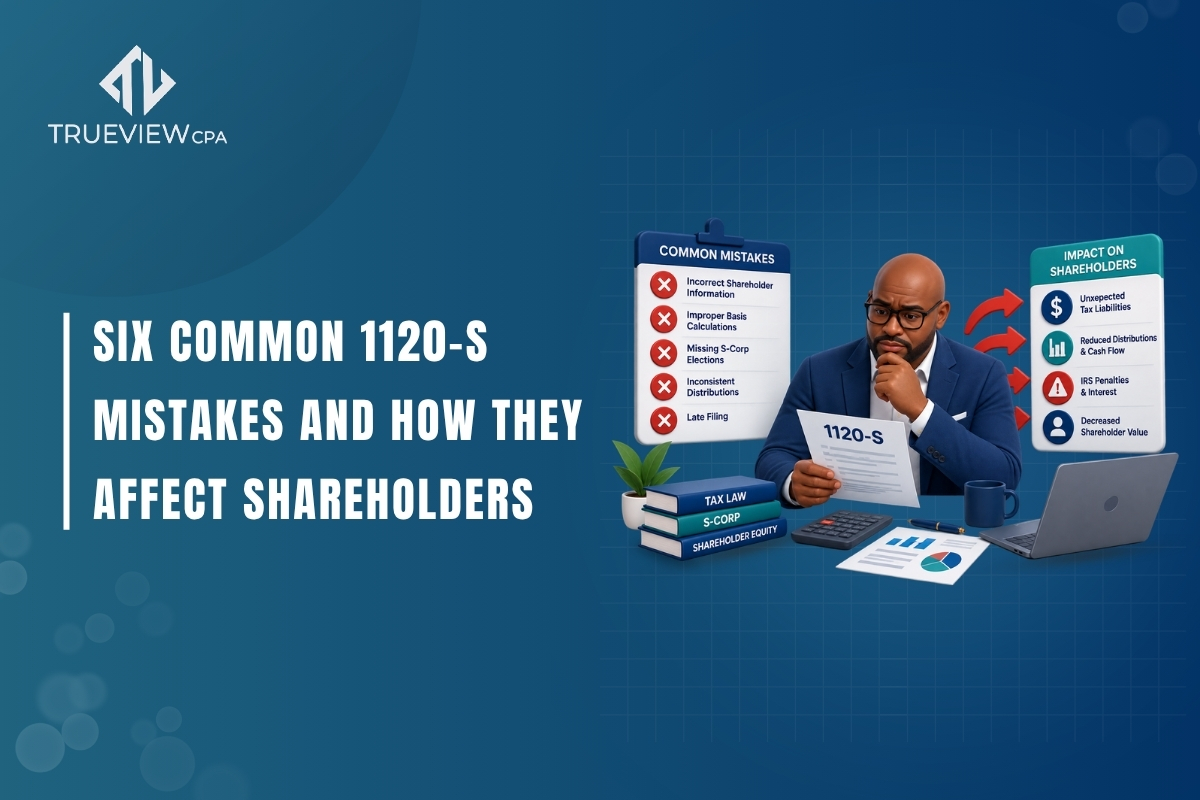
Most Form 1120-S errors are not dramatic. Nobody forgets to file entirely or reports a million dollars in the wrong column. The mistakes that cause real problems are quieter than that. They are misclassified income items, salaries set to minimize payroll taxes rather than reflect market rates, K-1s that do not reconcile to Schedule K, and basis calculations that were never maintained correctly to begin with. What makes these mistakes expensive is not what they do to the corporation. It is what they do to every shareholder whose personal return is built on top of that corporate filing.
An error on the Form 1120-S does not stay at the entity level. It travels to every K-1, and from there to every personal return connected to the corporation. Understanding which mistakes happen most often, and how they reach individual shareholders, is the starting point for making sure your return does not produce them.
According to the IRS, this is the single most audited issue on S-corp returns. Owner-employees who perform services for the corporation are required to receive a W-2 salary reflecting fair market compensation for those services before taking any distributions. When the salary is set too low to shift income from payroll-taxable wages to distribution income, the IRS reclassifies a portion of those distributions as wages.
The consequence at the corporate level is an assessment of back payroll taxes at 15.3 percent on the reclassified amount, an accuracy-related penalty of 20 percent under IRC Section 6662, and interest from the original due date. The consequence at the shareholder level is that the personal return must be amended to reflect the reclassification. The shareholder's W-2 income increases, the K-1 distribution income decreases, and the estimated tax payments made during the year may now represent an underpayment, generating its own penalty.
The IRS has won every significant court case on this issue. Watson v. Commissioner and Radtke v. United States both involved business owners who paid themselves dramatically below market rates. In both cases, the court found the compensation unreasonable and upheld reclassification. The IRS uses both court precedent and industry data to challenge salaries that do not reflect what the market would pay for the role.
Tip: Reasonable compensation is not a number you choose for tax efficiency. It is a number you document through Bureau of Labor Statistics wage data, industry salary surveys, and a written analysis of the shareholder's specific role and hours. Keep that documentation on file every year alongside the payroll records that support it.
The Schedule K-1 each shareholder receives must allocate income, deductions, and credits in proportion to each shareholder's ownership percentage. Unlike a partnership, an S-corp cannot make special allocations of specific items to specific shareholders. Everything flows pro-rata based on stock ownership, and the total of all K-1s issued must equal the Schedule K totals exactly.
When K-1 allocations are prepared using incorrect ownership percentages, or when a mid-year ownership change is handled incorrectly, some shareholders receive more income than their ownership warrants and others receive less. The IRS cross-references K-1 data against the Schedule K filed with the corporation. When a shareholder reports income on their personal return that does not match the K-1 the IRS received from the corporation, an automated notice follows.
Mid-year ownership changes are particularly prone to error. When a shareholder sells or transfers shares partway through the year, the income must be allocated between the two owners using either the daily proration method or, if all shareholders consent, the closing of the books method. Applying the wrong method or the wrong ownership percentages produces K-1s that are incorrect for both the departing and incoming shareholder.
Tip: If ownership changed during the year, confirm in writing before the return is filed whether the daily proration method or the closing of the books method will be used, and make sure all affected shareholders have agreed. The choice affects how much income each shareholder reports on their personal return, and a disagreement after the K-1s are issued is far more difficult to resolve than one addressed before filing.
Beginning with the 2021 tax year, the IRS requires shareholders to complete Form 7203 whenever they claim a loss from the S-corp, receive a distribution, dispose of S-corp stock, or receive a loan repayment from the corporation. Form 7203 tracks the shareholder's stock and debt basis, and it must be attached to the personal return in the applicable tax year.
A shareholder's ability to deduct losses from the S-corp is limited by their tax basis. Losses that exceed basis in the current year are suspended and carry forward to future years when basis is restored. Distributions reduce basis, and distributions that exceed basis are treated as capital gain. If basis is not tracked continuously from the first year of S-corp operation, these calculations cannot be performed accurately, and the errors compound each year that passes.
The most common version of this mistake is a shareholder who deducts a loss that exceeds their basis without knowing it, or treats a distribution as tax-free when it actually generates capital gain because the basis was already zero. Both produce incorrect personal returns that the IRS can challenge when it compares reported amounts against the K-1 the corporation filed.
Tip: Basis tracking is a multi-year obligation that starts on day one of S-corp operation. If the first year was not documented correctly, the error compounds forward into every subsequent Form 7203. The earlier this is corrected, the less expensive the fix, and it is worth addressing during the current year's preparation rather than waiting for an IRS notice to surface it.
The Schedule K separates income, deductions, and credits into specific categories because each one is taxed differently on the shareholder's personal return. Ordinary business income flows to Schedule E. Capital gains retain their character and are taxed at the applicable rate. Rental income follows passive activity rules. Interest and dividends are reported separately on Schedule B. Section 179 deductions flow through to each shareholder subject to their individual basis and at-risk limitations.
When income is placed on the wrong line of Schedule K, every K-1 derived from it carries the misclassification to every shareholder. A capital gain reported as ordinary business income costs every shareholder the preferential capital gains rate on that amount. Rental income reported as ordinary business income changes the passive activity treatment for shareholders who did not materially participate. Neither error is obvious from looking at the K-1 in isolation. Both produce personal returns that are incorrect in ways the IRS catches when it compares the character of income reported on the personal return against what the corporate return specified.
Tip: If your S-corp sold any assets during the year, do not assume the gain was automatically long-term capital gain. Depreciation recapture under IRC Sections 1245 and 1250 converts a portion of the gain to ordinary income, which must be reported on a separate line of the K-1 and taxed accordingly on each shareholder's personal return. A gain reported entirely as capital gain when it includes a recapture component understates each shareholder's ordinary income.
The accumulated adjustments account is the running balance of earnings that have already been taxed at the shareholder level and are available for tax-free distribution. Schedule M-2 on the Form 1120-S tracks this balance annually. The opening balance each year must match the closing balance from the prior year return exactly.
When the AAA is not maintained correctly, distributions that exceed the available balance are treated as returns of capital up to the shareholder's stock basis, and then as capital gain. A shareholder who receives a distribution believing it to be tax-free, because the corporation told them the AAA was sufficient, and then discovers the AAA was understated faces an unexpected capital gain on their personal return and potentially an amended filing.
The AAA is also affected by items that reduce it, including ordinary losses, nondeductible expenses, and certain distributions. A corporation that tracks only the income additions and ignores the reduction items gradually overstates the AAA, and the error surfaces when a distribution is made that the AAA cannot actually support.
Tip: The Schedule M-2 on this year's return must open with the exact closing balance from last year's Schedule M-2. If those two numbers do not match and nobody can explain why, something went wrong in a prior year that should be traced before the current return is filed. An unexplained M-2 discrepancy is the kind of thing that becomes significantly more expensive the longer it goes unaddressed.
Filing the Form 1120-S on time is only half the obligation. The corporation must also furnish a Schedule K-1 to every shareholder by the same deadline. For the 2025 tax year, that was March 16, 2026. Failing to deliver K-1s on time carries a separate penalty of $330 per K-1 under IRC Section 6722, on top of any Form 1120-S late-filing penalty already assessed under Section 6699. Both penalties can apply to the same filing failure simultaneously.
Late K-1s force every shareholder to extend their personal return. Shareholders who already filed based on estimated figures may need to amend if the actual K-1 differs from their estimate. In a multi-shareholder S-corp, one corporation's missed deadline creates administrative disruption across multiple personal tax situations.
Tip: The K-1 deadline and the Form 1120-S deadline are the same date. If the corporation is filing on extension, shareholders need to know before April 15 so they can extend their personal returns. A shareholder who files their personal return on April 15 based on an estimated K-1 and then receives a corrected K-1 in September is almost certainly looking at an amended return.
Every error described above shares the same root cause. The Form 1120-S was treated as a routine annual filing rather than a return that requires genuine attention to how each item is classified, how each K-1 is allocated, and how the corporate return connects to every shareholder's personal tax picture.
A well-prepared 1120-S does more than satisfy a filing obligation. It protects every shareholder's personal return for the year that follows.
At TrueView CPA, S-corp tax return preparation and S-corporation tax filing services for business owners across Dallas and Texas are built around preventing exactly these mistakes before they reach the shareholders. If you have received a K-1 that does not look right, want a second opinion on a return already filed, or need professional S-corp tax preparation before the next March deadline, we are ready to start with a conversation.
Want to avoid costly 1120-S mistakes? Schedule a call with our tax experts today.
.svg)
.png)
