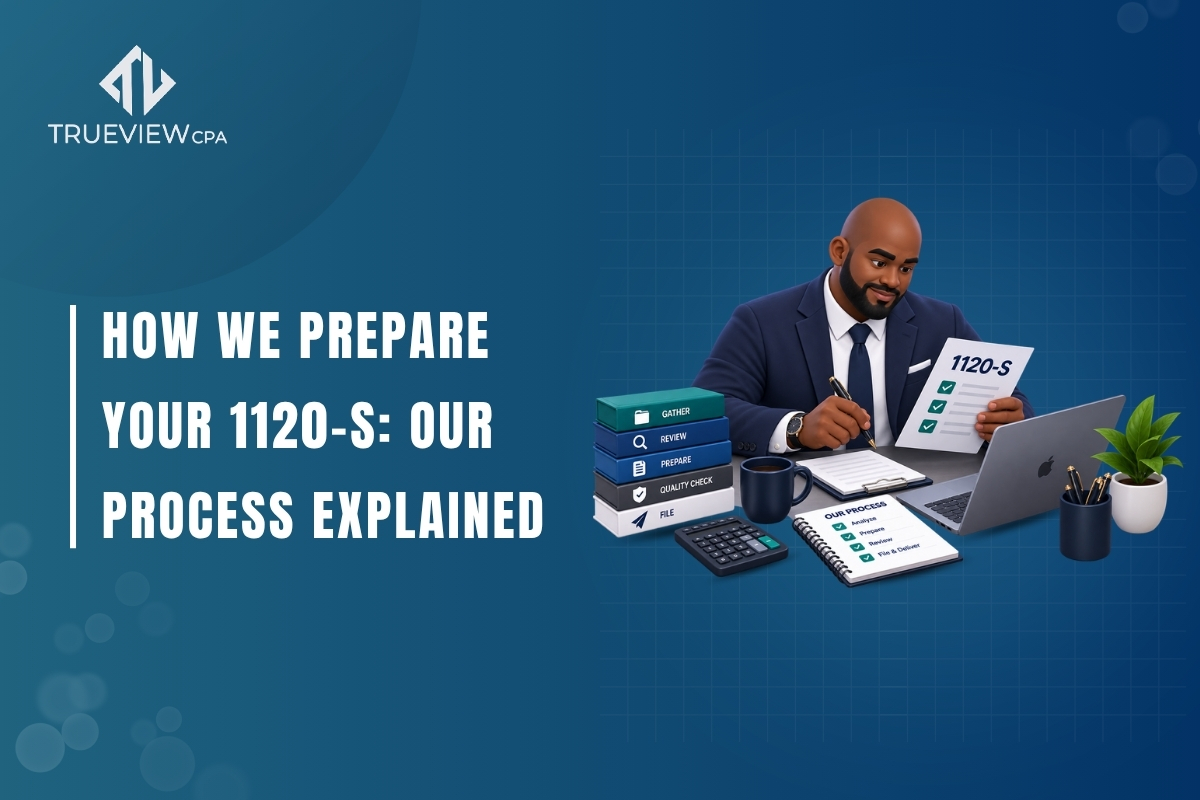
When a new client asks how long the Form 1120-S will take, the honest answer depends less on the size of the corporation and more on how the engagement starts. A well-organized engagement with clean books, documented reasonable compensation, and complete shareholder information moves efficiently. One that starts with partial records, unresolved payroll questions, and a scramble in early March does not. The process we follow at TrueView CPA is built around making sure every 1120-S we prepare falls into the first category, not the second.
Here is exactly how that process works, from the first conversation to the moment every shareholder receives their K-1.
Before a single document changes hands, we talk. Not a questionnaire dropped in a portal, but an actual conversation about the corporation, how it operated during the year, what changed, and what we need to understand before the return is built.
That conversation covers:
This conversation matters because the Form 1120-S is not a data entry exercise. It is a return that requires understanding the facts before any numbers are entered. The intake conversation is how we get those facts, and it is what separates a return built on accurate information from one built on assumptions.
Tip: If you are bringing TrueView CPA a return we did not prepare in prior years, the most useful thing you can provide at the intake conversation is your prior year Form 1120-S, all K-1s issued, and the payroll records showing what compensation was paid to owner-employees. Prior year returns establish the AAA opening balance, shareholder basis figures, and any elections the corporation has made. Without them, we are building the current year return without a foundation.
After the intake conversation, we send you a tailored document request. Not a generic list of everything a tax firm has ever needed from any client, but a specific list of what your corporation's return actually requires, with an explanation of why each item is needed.
For most S-corps, that document request covers:
We follow up specifically if anything is missing. We do not wait for February to become March and then ask where the documents are.
Tip: Clients who deliver complete, reconciled records in early February consistently receive more accurate returns with more time for review than those who arrive in the final two weeks before the March 16, 2026 deadline. That runway is where the careful work happens, and it is the first thing that disappears when documents arrive late.
Before any schedule is prepared, we review how the corporation compensated its owner-employees during the year. This is not a formality. According to the IRS, unreasonable or absent officer compensation is the most audited issue on Form 1120-S returns, and the consequences of getting it wrong are expensive for both the corporation and the shareholder.
We review whether the salary paid to each owner-employee is consistent with market data for their specific role, industry, and geography. We verify that the compensation determination is supported by documentation that can withstand IRS scrutiny. We confirm that health insurance premiums paid for shareholders owning more than 2 percent of the corporation are properly included in W-2 wages and deducted by the corporation under the applicable rules.
If the compensation has not been analyzed or documented, we address that before the return is filed, not after. A salary that cannot be defended is a liability on every Form 1120-S it appears on.
Tip: Watson v. Commissioner established in 2012 that the IRS will reclassify distributions as wages when it determines compensation was unreasonable. A salary supported by written documentation referencing market data is the difference between a defensible return and one that is exposed from the moment it is filed.
With documents reviewed and compensation confirmed, we build the return across every schedule it requires. For a standard S-corp, that means:
We also evaluate whether the corporation qualifies for and should make specific elections, confirm the S-corp election is still valid, and verify that the shareholder basis calculations are current and documented on Form 7203 where required.
Tip: The M-2 opening balance on the current year return must match the M-2 closing balance from the prior year return exactly. If those two numbers differ, something went wrong in a prior year that must be traced before the current return is completed. An unexplained M-2 discrepancy compounds forward into every return that follows it.
Before a single K-1 goes to a shareholder and before the return is filed with the IRS, we reconcile. The total of every K-1 issued to every shareholder must equal exactly what is reported on Schedule K, line by line. Every capital account balance must tie to the prior year's closing balance, adjusted for current year contributions, distributions, and allocated income or loss. Every schedule must be internally consistent and tied to the source records.
This is the step that catches errors before they become problems on shareholder personal returns rather than after. It is also the step most commonly skipped when a preparer is working under deadline pressure with more returns than time. We do not skip it.
Once reconciliation is complete, the return is reviewed internally before it reaches you. You review the return with us and have the opportunity to ask questions about anything that does not look right before anything is filed.
Tip: According to the IRS, a Form 1120-S is not a valid return unless it is signed by an officer of the corporation. You will sign off on the final version after your review. That is your confirmation that the return reflects the facts of the corporation's year as you understand them, not a formality.
Once the return is approved and signed, we file electronically and send you confirmation when the IRS accepts it. You receive a complete copy of the filed return for your records. If state filings are required, including the Texas franchise tax return for qualifying corporations, those go out at the same time.
Every shareholder receives their K-1 by March 16, 2026, the filing deadline for the 2025 tax year. Each K-1 comes with a plain-language explanation of what is on it, how it flows to the shareholder's personal return, and what it means for their estimated tax payment obligations going forward. Shareholders should not receive a K-1 and wonder what it means. By the time ours arrive, that conversation has already happened.
After filing, we stay available. If the IRS sends a notice about the return, we respond. If a shareholder's personal preparer has questions about a K-1 line item, we answer them. If a significant transaction is being considered before year-end, we want to be part of that conversation before December 31, not after.
Tip: The penalty for failing to furnish K-1s to shareholders on time is $330 per K-1 under IRC Section 6722, on top of any failure-to-file penalty assessed against the corporation. Every K-1 we issue goes out by the filing deadline, not after it.
Shareholders who work with TrueView CPA for their 1120-S consistently tell us the same things. That the process was more organized than they expected. That they understood their K-1 for the first time. That they left the engagement knowing what their return actually said, not just that it had been filed.
That is the goal. S-corp tax preparation that leaves every shareholder more informed, more protected, and better positioned going into the year ahead than they were at the start of it.
If you are ready to find out what that experience looks like for your corporation, the first step is a conversation.
.svg)
.png)
