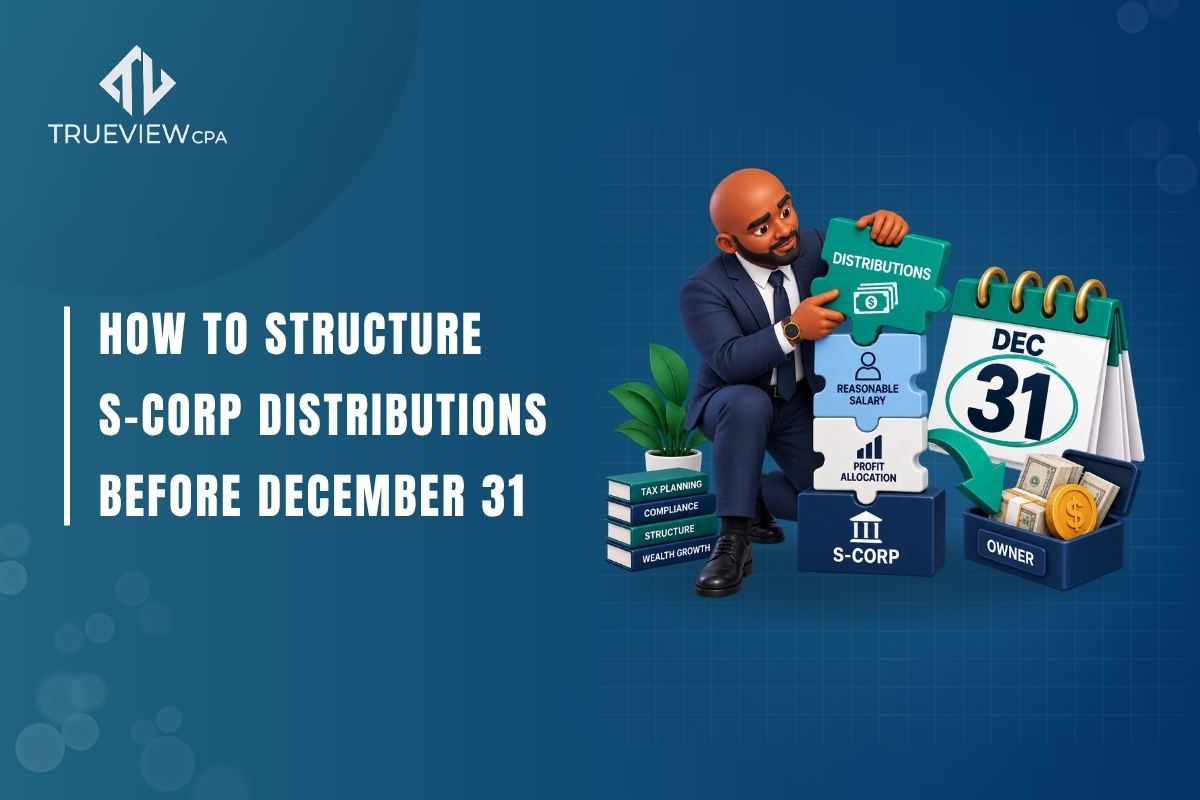
Distributions from an S-corp are one of the primary tax advantages of the structure. Unlike salary, distributions are not subject to payroll taxes. Unlike partnership draws, they have specific rules around the accumulated adjustments account and shareholder basis that determine whether each dollar is tax-free, a return of capital, or a taxable capital gain. Those rules do not change based on when the distribution is taken, but the decisions made before December 31 determine how the year-end picture looks and whether any last-minute adjustments are still available.
This post explains how S-corp distributions work, what controls their tax treatment, and what owners should confirm before the year closes.
The tax treatment of an S-corp distribution depends on two things: the shareholder's stock basis in the corporation and, for S-corps that were previously C corporations, the accumulated adjustments account balance. For a corporation that has operated as an S-corp from inception and has never carried C corporation accumulated earnings and profits, the analysis is straightforward: distributions are tax-free up to the shareholder's stock basis, and any excess is capital gain.
Stock basis starts with the amount the shareholder paid for their shares. It increases each year by the shareholder's allocated share of corporate income, including income that was reported on the K-1 and taxed even if not distributed. It decreases by distributions received and by the shareholder's share of corporate losses. The ordering matters: under IRS rules, income increases basis before distributions reduce it. In a profitable year, the income allocated to the shareholder on the K-1 increases their basis first, which means that year's distribution is typically absorbed within the existing basis without triggering capital gain — even if the distribution equals or slightly exceeds the beginning-of-year basis figure.
For S-corps that converted from C corporation status and carry accumulated earnings and profits from C corporation years, the distribution analysis adds a layer. Distributions come first from the accumulated adjustments account, then from C corporation earnings and profits as a taxable dividend, and then as a return of capital up to basis, with any remainder as capital gain. That three-tier structure makes prior-period earnings and profits a planning consideration for any corporation with a C corporation history.
Tip: In a profitable year, do not assume your beginning-of-year basis limits your distributions. The K-1 income allocated for the current year increases your basis before distributions reduce it. Ask your CPA for your projected year-end basis before concluding that a planned distribution would exceed basis and trigger capital gain.
Unlike a partnership, an S-corp cannot make distributions in different amounts to different shareholders outside of their exact ownership percentages. Every distribution must be proportional to stock ownership. A distribution of $100,000 in an S-corp with two 50 percent shareholders must result in $50,000 to each shareholder. No exceptions, no agreement to the contrary, and no workaround through other economic arrangements that create the same effect.
This is not a technicality. A distribution that gives one shareholder preferential economic treatment over another can be characterized by the IRS as creating a second class of stock, which terminates the S-corp election automatically. The correction process for an inadvertent election termination is expensive, requires IRS consent to re-elect, and imposes a five-year waiting period before the corporation can elect S-corp status again.
Before taking any year-end distribution, confirm that the amount and timing are consistent across all shareholders in proportion to their exact ownership percentages. If different shareholders want different amounts of cash out of the business at year-end, the solution is not disproportionate distributions. It is a shareholder loan or a salary adjustment, both of which have their own requirements.
Tip: If the S-corp has shareholders who are not active in the business and may not want or need the same distribution amount as the active owners, that structural tension is worth discussing before year-end. The only way to distribute different amounts to different shareholders is to change their ownership percentages, which has its own tax consequences and documentation requirements.
For any S-corp operating without C corporation accumulated earnings and profits — which describes most small businesses that elected S-corp status from the start — the accumulated adjustments account is a tracking mechanism rather than a tax liability gate. Distributions up to the shareholder's basis are tax-free regardless of the AAA balance for these corporations. The AAA is still maintained on Schedule M-2 of the Form 1120-S and must be accurate for the return to be correct.
For S-corps that do carry C corporation accumulated earnings and profits, the AAA balance is critical. Distributions come from the AAA first, then from C corporation earnings and profits as a taxable dividend. A distribution that draws down the AAA to zero and then reaches into C corporation accumulated earnings and profits produces a dividend that was not expected and was not planned for. Shareholders who took those distributions assuming they were tax-free face a significant tax liability that cannot be undone after the year closes.
Before any material year-end distribution is taken from an S-corp with a C corporation history, confirm the current year AAA balance with your CPA. The year-end AAA projection must include the current year income addition before calculating whether the proposed distribution stays within the account.
Tip: Ask your CPA specifically whether the corporation carries any accumulated C corporation earnings and profits from prior C corporation years. If the answer is yes, confirm the current AAA balance and the E&P balance before approving any year-end distribution. The consequences of mistakenly treating a dividend as a tax-free distribution are not correctable after December 31.
The IRS requires that basis adjustments be applied in a specific order: income increases basis first, then basis is reduced by distributions, then by losses. This ordering rule is actually beneficial to shareholders in profitable years because it means the current year's income, which has already been taxed or will be taxed on the shareholder's K-1, creates basis that absorbs that same year's distributions.
A shareholder who began the year with $40,000 in stock basis, received a K-1 showing $80,000 in ordinary income, and then took a $100,000 distribution during the year is not looking at $60,000 in capital gain. The income increased the basis to $120,000 before the distribution reduced it. The ending basis is $20,000, and the entire $100,000 distribution was tax-free.
That same shareholder who took $100,000 in distributions during a year when the corporation showed a $10,000 loss would have a different result. Basis decreases from losses reduce basis after the distribution ordering, but the picture is less straightforward and requires the full year-end calculation before the tax result is clear.
Tip: Never estimate whether a distribution is within basis based solely on the beginning-of-year balance. The full year-end basis calculation includes current year income and losses that have not yet been finalized at the time most year-end distributions are taken. Get a projected basis figure from your CPA before taking a large distribution in Q4.
A distribution that exceeds the shareholder's adjusted stock basis produces capital gain, not ordinary income. For a shareholder who has held their S-corp stock for more than one year, that capital gain is long-term and is taxed at the preferential capital gains rate, such as 0, 15, or 20 percent depending on the shareholder's taxable income for 2026. That is a significantly lower rate than ordinary income tax for most shareholders, but it is still a tax event that was not anticipated if the basis calculation was not done before the distribution was taken.
For shareholders near the 3.8 percent Net Investment Income Tax threshold, which is $200,000 for single filers and $250,000 for joint filers, capital gain from an excess distribution can push them into NIIT territory for the first time, adding almost four percentage points to the effective rate on that gain.
Tip: A shareholder who receives a distribution that exceeds their basis will need to report capital gain on Schedule D of their personal return and pay tax on it even if they assumed the distribution was tax-free. If that tax was not factored into their estimated payments for the year, they may also face an underpayment penalty. Catching an excess distribution in Q4 while there is still time to make an estimated payment is significantly better than discovering it in March when the return is prepared.
Every distribution taken from an S-corp should be documented. The documentation does not need to be elaborate, but it needs to exist: a board resolution or written consent authorizing the distribution, the date and amount of the distribution, and the record confirming it was distributed proportionally to all shareholders in accordance with ownership percentages.
That documentation protects the corporation if the IRS ever questions whether a payment was a distribution or compensation. It also provides the clear paper trail that supports the Schedule M-2 entries on the Form 1120-S for the year. A distribution that appears on the bank statement but has no corresponding corporate resolution can create reconciliation questions during preparation and raises the same questions an examiner would raise during an audit.
Tip: Year-end distributions processed before December 31 must clear the bank by December 31 to be distributions in the current tax year. A check written on December 29 and deposited by the shareholder on January 3 is a distribution in January for tax purposes. Confirm the payment timing with your bank and your payroll or accounting system before assuming December distributions will be recorded correctly in the current year.
The decisions that determine whether year-end distributions are tax-free, taxable at the capital gains rate, or inadvertently taxable as a dividend all converge in Q4. The AAA balance, the shareholder's projected year-end basis, the proportionality requirement, and the documentation all need to be confirmed before the final distribution of the year is processed.
At TrueView CPA, S-corp tax preparation and S-corporation tax filing services for business owners across Dallas and Texas include year-end distribution planning as part of every engagement. If you want to confirm your basis position, verify your AAA balance, or structure Q4 distributions correctly before December 31, we are ready to start with a conversation.
Need help with S-Corp distributions? Schedule a call with our tax experts today.
.svg)
.png)
